
From April 3 to 9, 2026, Min-On sent three Japanese traditional musicians to the Republic of Korea to participate in the Korea-Japan Youth Concert 2026. The concerts in Seoul and Busan brought together young traditional musicians from both countries, including several artists who had first performed together at a friendship concert in Japan the previous year.

On April 8 in Busan, we spoke with Tsugaru shamisen performer Sho Asano, 25-string koto performer Takashi Honma, and Korean janggu performer Jin-Hee Lee. The three musicians reflected on their reunion, the ways in which music enables people to communicate beyond the boundaries of language, and the hope and connection fostered through cultural exchange.
◆ Watch the interview highlights below
MIN-ON: This was the second year that the three of you have performed together. How did it feel to reunite, and what moments from this year’s performances were particularly memorable?
Lee Jin-Hee: It was wonderful to perform with the two of them again. Although we still cannot fully communicate through words, seeing them again felt as though we had only parted yesterday. Building on last years’ experience, this year’s collaboration felt both fresh and even more enjoyable. I was truly happy to be together again.

Honma Takashi: Because we had performed together the previous year, there was a strong sense of familiarity and reassurance from the very beginning. Although we were the ones traveling to Korea this time, it somehow felt as though we were returning to a familiar place. At the Busan National Gugak Center, every aspect of the staging and acoustics had been carefully prepared, allowing us to perform with confidence and fully immerse ourselves in the experience.
Asano Sho: Once you have performed together, it feels as though your hearts are already connected. When we performed together again in Korea after a year apart, everything came together so naturally that I hardly noticed the time that had passed. I could feel that we still understood one another intuitively, which made me very happy.

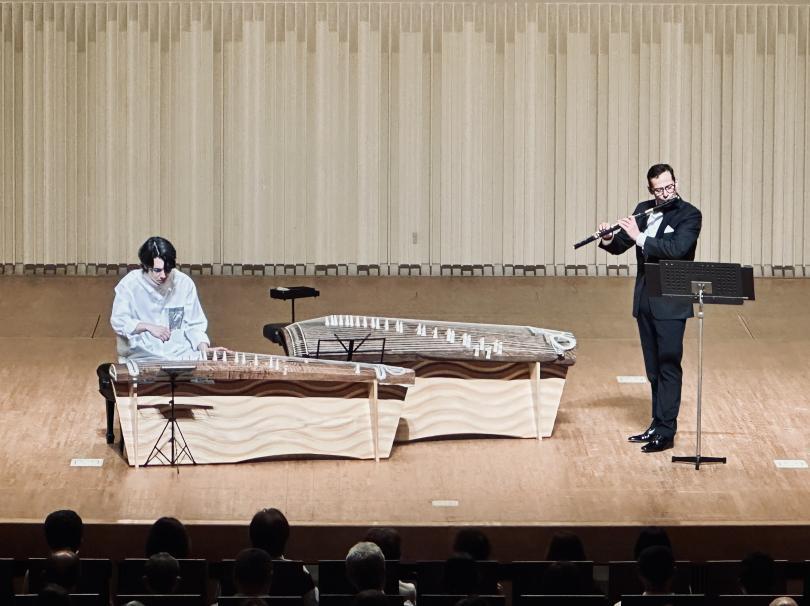
Korea–Japan Youth Concert (Japan, 2025)
MIN-ON: Through this Korea–Japan exchange, what did you come to appreciate about the power and significance of cultural exchange through music?
Honma Takashi: Korea is geographically very close to Japan, and the two countries share many cultural similarities. At the same time, Korea has its own distinctive culture, and there are moments when I am keenly aware that I am experiencing something uniquely Korean. I think it is this interplay of similarities and differences that makes culture so fascinating.
As performers of traditional instruments, we share a common foundation in traditional arts. Through music, we can connect with one another and share the same emotions, transcending cultural differences.

Asano Sho: Even within Japan, culture, language, musical rhythms, and dialects vary from region to region. When we bring the traditional music, we have cultivated in Japan and perform it alongside musicians from other countries, we encounter emotions we have never experienced before, as well as new challenges and discoveries.
Korea and Japan are very close and, in many ways, similar, yet they are not the same. When performing together, there are pieces that feel very natural and comfortable as an ensemble, and other moments that reveal something distinctly Korean—something that does not exist within me as a Japanese musician. Being able to experience those differences through music is one of the great powers of cultural exchange.
Although our music and cultures may differ, we are all human beings. I hope we can continue to build friendship and deepen cultural exchange through the shared language of music, and bring what we gain from these encounters back into our own musical activities. To me, that is one of the greatest joys and meanings of performing together.

Lee Jin-Hee Whenever I take part in cultural exchange, I am reminded of this more than ever. In a world marked by war, division, conflict, and cultural prejudice, each encounter through music reinforces my belief that the more we engage with one another, the more deeply we realize that, at heart, we are all connected.
Although Korea and Japan are geographically close, they can sometimes feel far apart, and we do not share the same language. Even so, it has been a true joy to perform with young artists who share my passion for traditional music. This experience has filled me with renewed hope that we can move forward together, united through culture and music. I am sincerely grateful to everyone who came to Busan.
Profiles
Inspired by his grandfather, Asano began playing Japanese taiko drums at the age of three and took up the Tsugaru shamisen at five. He studied the shamisen under Tokuo Odashima II of the Sangen Odashima school. At just seven years old, he became the youngest performer ever to appear at the Tsugaru Shamisen World Convention. He later captured the competition’s highest honor for three consecutive years, earning induction into the Tsugaru Shamisen Hall of Fame. Asano made his major-label debut with Victor Entertainment at the age of 17. In recent years, he has actively promoted Japanese culture both in Japan and abroad through initiatives such as the Nippon Takaramono Project and the Japanese government’s beyond 2020 program. As a solo performer, he is dedicated to sharing the unique appeal of the Tsugaru shamisen through both its rich traditional repertoire and his own original compositions.
Takashi Honma began studying the koto under his mother at the age of three and took up the shamisen at twelve. He graduated from the Music Program in the Department of Arts at Toho Gakuen College of Drama and Music, before completing both its Advanced Course and Research Student Program. He was awarded First Prize in the Chamber Music Division of the 7th Romania International Music Competition, where he also received the Board of Directors’ Award. His media appearances include NHK General TV’s Minyo Damashii, NHK WORLD-JAPAN’s Blends, and the television anime Kono Oto Tomare!: Sounds of Life. In addition to his concert career, he has performed in stage and film productions and contributed to numerous recording projects. In 2019, he made his major-label debut with Avex as a member of Sakura men (Sakura men). He serves as assistant director of Fumine-kai, an Ikuta-school koto music association; a board member of the Gunma Sankyoku Association; and general director of the artist collective ICHI. He is affiliated with the headquarters of the Mizuno Sokyoku Academy and is also a member of MIKAGE PROJECT.
Lee Jin-Hee serves as Concertmaster of the Instrumental Ensemble and Acting Artistic Director of the Instrumental and Vocal Ensembles at the Busan National Gugak Center. Lee graduated from the Department of Korean Music at Pusan National University, where she also earned her master’s degree. After completing the doctoral coursework at the university’s Graduate School, she joined her alma mater as a faculty member, while continuing her distinguished career as both a performer and educator.
◆ Concert News
If you have any comments regarding this article, please feel free to email us at:
Min-On Concert Association
—Music Binds Our Hearts—