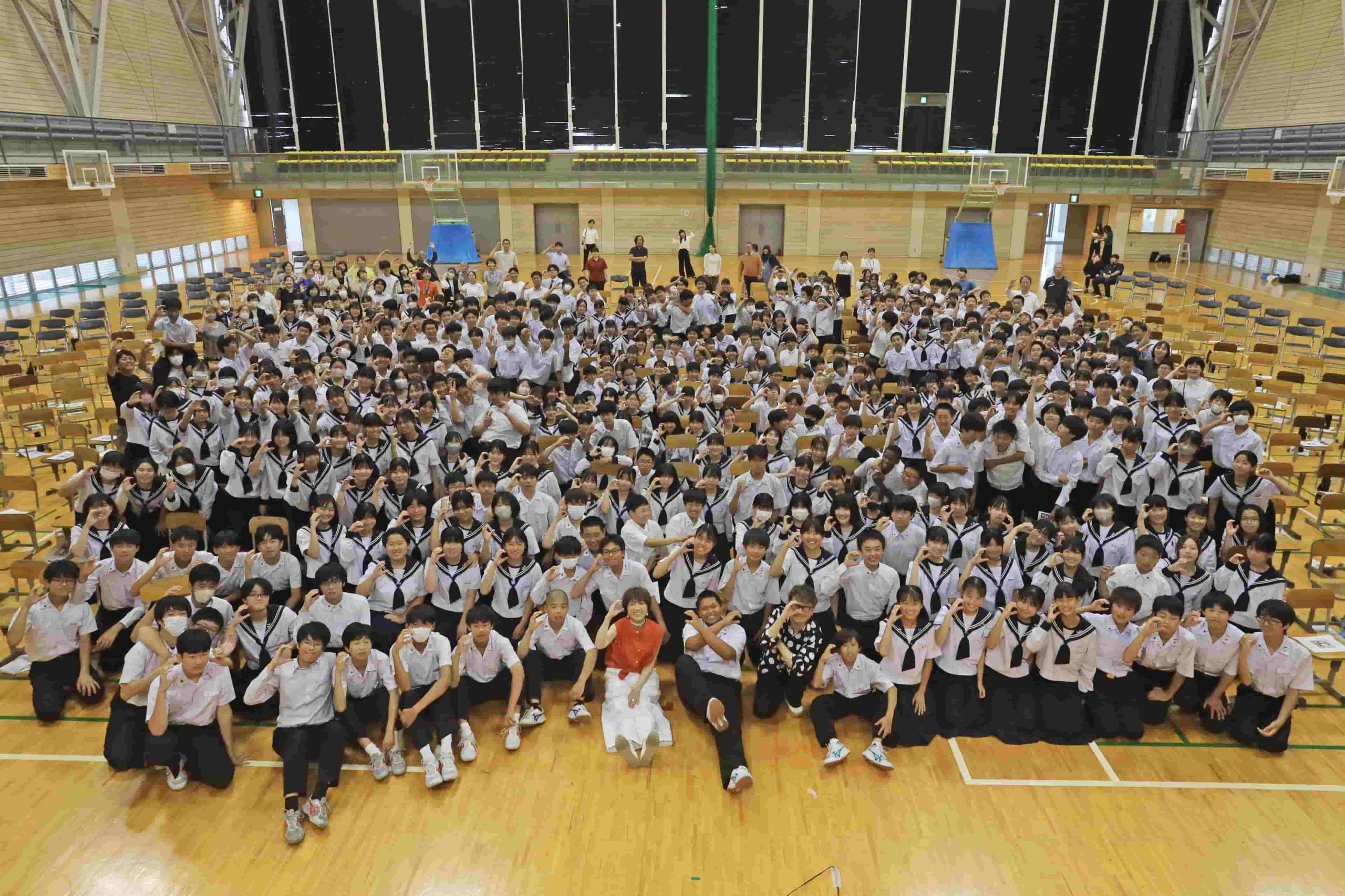

On July 25, 2026, approximately 750 people gathered at Orinasu Yame, the Yame Civic Hall in Fukuoka Prefecture, for a cultural lecture titled “White Hands Chorus: Music Connecting Our Future.”

The lecture featured soprano singer Ms. Erika Colon, Representative Director of El Sistema Connect Japan and Artistic Director of White Hand Chorus NIPPON, who shared the story and vision behind the ensemble through video and photographs.
Opening remarks were delivered on behalf of Mayor Yutaro Minohara by Deputy Mayor Ryoichi Hara, followed by an address from H.E. Mr. Seiko Luis Ishikawa Kobayashi, Ambassador Extraordinary and Plenipotentiary of the Bolivarian Republic of Venezuela to Japan, who expressed gratitude for Japan’s support following the devastating earthquake that struck Venezuela.

White Hand Chorus NIPPON is an inclusive choir in which children of all abilities — with and without disabilities — create music together. The ensemble is composed of a sign team, who perform songs through hand signs and a vocal team, and operates under the philosophy of El Sistema, the Venezuelan social music movement.
White Hand Chorus NIPPON is an inclusive choir in which children of all abilities—with and without disabilities—create music together. The ensemble consists of a Sign Team, whose members express songs through sign language, and a Voice Team, and is guided by the philosophy of El Sistema, Venezuela’s internationally renowned social music movement.

In her lecture, Ms. Colon introduced the chorus’s activities — from performances at the Kyoto City Council to participation in the Beethovenfest Bonn in Germany and a performance of Beethoven’s Symphony No. 9 “Ode to Joy” at the United Nations Office in Vienna. She identified three forces at the heart of the work: Imagination (the capacity to imagine another’s pain), Creation (the power to overcome barriers through creativity), and Innovation (to inspire and move people). Throughout, she emphasized the importance of building a society where differences are embraced and each person can feel that they are valued just as they are.

She described the white gloves worn by the Sign Team as “a new musical instrument and a symbol of joy and inclusion.” She explained that they represent sharing one another’s happiness and remind us that today’s children are the ones who will shape tomorrow’s society. She added that music has the power to transcend the invisible barriers that separate people and to help create a society where everyone can express themselves freely.
The lecture concluded with the entire audience performing Hana wa Saku (Flowers Will Bloom) using hand signs together. The song was arranged as a message of encouragement from Venezuela—the birthplace of El Sistema—to the people of Japan recovering from the Great East Japan Earthquake. As the audience followed Ms. Colon’s gestures in unison, the hall was filled with smiles and a profound sense of shared

Voices from Participants:
“I am hard of hearing, and this experience made me want to sing with hand signing and feel the music to bring people together and break down barriers. I hope we can build a society where we think about children’s futures together, rather than having prejudice about one another.”
“Watching the children in the videos smile and honor each other’s individuality while creating harmony together was deeply moving. It reminded me how important it is to embrace our differences, and I hope this work continues to grow.”
“This was my first time learning about White Hands Chorus, and it made me feel, concretely, how music and human connection have the power to change society. Something inside me opened up — and joining everyone in the hall for Hana wa Saku with hand signing at the end is something I will carry with me.”
This program was made possible through the generous support of Min-On’s sustaining members, to whom we extend our sincere appreciation.